

Burden of disease
Pneumococcal pneumonia | Invasive pneumococcal disease (IPD) | Vaccination rates
Invasive pneumococcal disease (IPD)
The same bacteria that cause pneumococcal pneumonia, Streptococcus pneumoniae, can invade normally sterile sites in the body, such as the blood or cerebrospinal fluid. When this occurs, it is referred to as invasive pneumococcal disease or IPD. IPD is a serious illness that can lead to hospitalization, complications including bacteremia and meningitis, and sometimes death.1
~3x
Healthy adults 50-64 are at ~3x increased risk of hospitalization from both pneumococcal pneumonia and IPD compared to healthy adults 18-49.2,a
Risk of IPD
IPD death rates
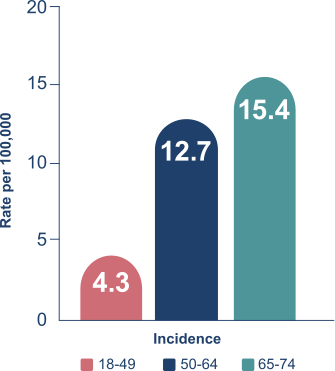
IPD incidence rates for adults 50-64 are comparable to those in adults 65-743-7,a
IPD incidence rates across adults 18–74, 2019-2023
IPD rates peak between the ages of 55-59 in Black adults8
Approximate IPD rates among Black adults, 2018–20198,9,*
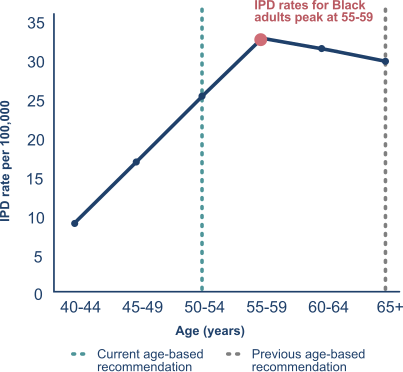
*Based on 2018–2019 CDC ABCs unpublished data.
†Study design: Based on a 2017 analysis where population health status data from the 2014 National Health Interview Survey and 2012 National Center for Health Statistics databases were used to compare the likelihoods of chronic health conditions at high-risk for pneumococcal disease in black and non-black populations aged 50 years and older.
High-risk conditions were categorized into those with immunocompromising conditions, other high-risk comorbid conditions, current cigarette smoker, or no condition subgroups based on CDC definitions.10
IPD death rates
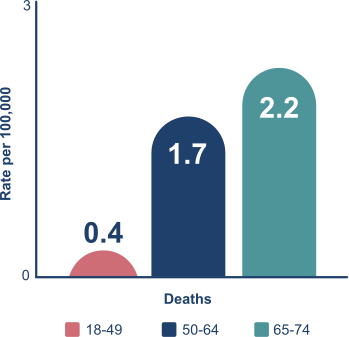
~1 in 7 cases of IPD in adults aged 50 or older resulted in death3-7,a
Furthermore, IPD death rates for adults 50-64 and 65-74 are higher than those for adults 18-49.
IPD death rates across adults 18–74, 2019-2023

Are high-risk adults getting vaccinated?
Look at the percentages of eligible adults who actually received pneumococcal vaccinations.
Share with health care professionals
aBased on CDC ABC surveillance data from the years 2019–2023, representing ~35 million persons and 10 states across the US.3-7
ABC, Active Bacterial Core; CDC, Centers for Disease Control and Prevention; IPD, invasive pneumococcal disease; US, United States.
References:
- Gierke R, Wodi P, Kobayashi M. Epidemiology and Prevention of Vaccine-Preventable Diseases (Pink Book). 14th edition. Chapter 17: Pneumococcal disease. Centers for Disease Control and Prevention. May 1, 2024. Accessed August 15, 2025. https://www.cdc.gov/pinkbook/hcp/table-of-contents/chapter-17-pneumococcal-disease.html
- Pelton SI, Bornheimer R, Doroff R, Shea KM, Sato R, Weycker D. Decline in pneumococcal disease attenuated in older adults and those with comorbidities following universal childhood PCV13 immunization. Clin Infect Dis. 2019;68(11):1831-1838. doi:10.1093/cid/ciy800
- Active Bacterial Core surveillance (ABCs) report, Emerging Infections Program network, Streptococcus pneumoniae, 2019. Centers for Disease Control and Prevention. Updated June 16, 2021. Accessed August 1, 2025. https://www.cdc.gov/abcs/downloads/SPN_Surveillance_Report_2019.pdf
- Active Bacterial Core surveillance (ABCs) report, Emerging Infections Program network, Streptococcus pneumoniae, 2020. Centers for Disease Control and Prevention. Updated September 20, 2022. Accessed August 1, 2025. https://stacks.cdc.gov/view/cdc/140328
- Active Bacterial Core surveillance (ABCs) report, Emerging Infections Program network, Streptococcus pneumoniae, 2021. Centers for Disease Control and Prevention. Updated June 2, 2023. Accessed August 4, 2025. https://www.cdc.gov/abcs/downloads/SPN_Surveillance_Report_2021.pdf
- Active Bacterial Core surveillance (ABCs) report, Emerging Infections Program network, Streptococcus pneumoniae, 2022. Centers for Disease Control and Prevention. Updated July 5, 2024. Accessed August 1, 2025. https://www.cdc.gov/abcs/downloads/SPN_Surveillance_Report_2022.pdf
- Active Bacterial Core surveillance (ABCs) report, Emerging Infections Program network, Streptococcus pneumoniae, 2023. Centers for Disease Control and Prevention. Updated March 20, 2025. Accessed July 28, 2025. https://www.cdc.gov/abcs/downloads/SPN_Surveillance_Report_2023.pdf
- Kobayashi M. Summary of work group interpretation of EtR and policy options: PCV use in adults aged ≥50 years. Slide deck presented at: Advisory Committee on Immunization Practices Meeting; October 23, 2024; Atlanta, GA. Accessed January 21, 2026. https://www.cdc.gov/acip/downloads/slides-2024-10-23-24/04-Kobayashi-Pneumococcal-508.pdf
- Kobayashi M, Leidner AJ, Gierke R, et al. Expanded recommendations for use of pneumococcal conjugate vaccines among adults aged ≥50 years: recommendations of the Advisory Committee on Immunization Practices — United States, 2024. MMWR Morb Mortal Wkly Rep. 2025;74(1):1-8. doi:10.15585/mmwr.mm7401a1
- Nowalk MP, Wateska AR, Lin CJ, et al. Racial disparities in adult pneumococcal vaccination indications and pneumococcal hospitalizations in the U.S. J Natl Med Assoc. 2019;111(5):540-545. doi:10.1016/j.jnma.2019.04.011
- Kobayashi M. Summary of work group interpretations of EtR and policy option on PCV21 use in adults. Slide deck presented at: Advisory Committee on Immunization Practices Meeting; June 26-28, 2024; virtual.