
Actor Portrayal

VAQTA® (Hepatitis A Vaccine, Inactivated) 
pediatric flexible dosing schedule1

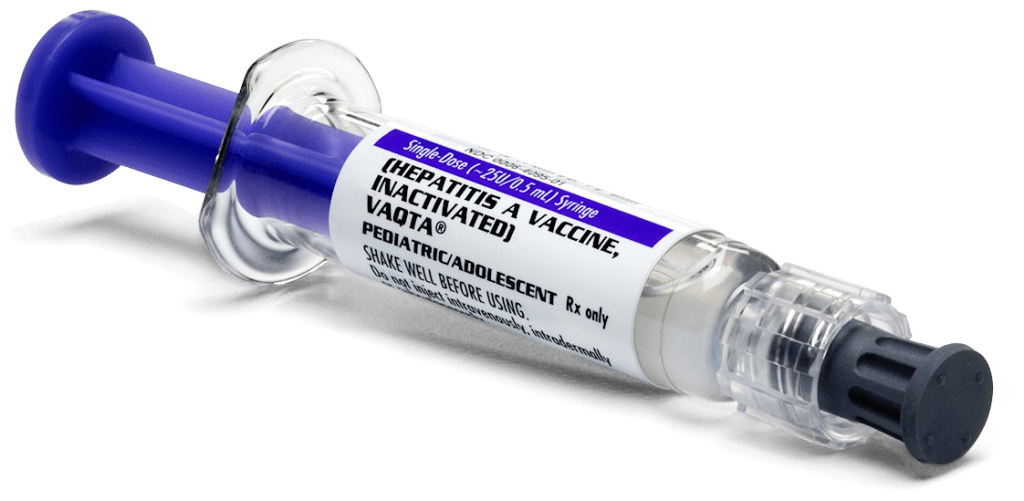
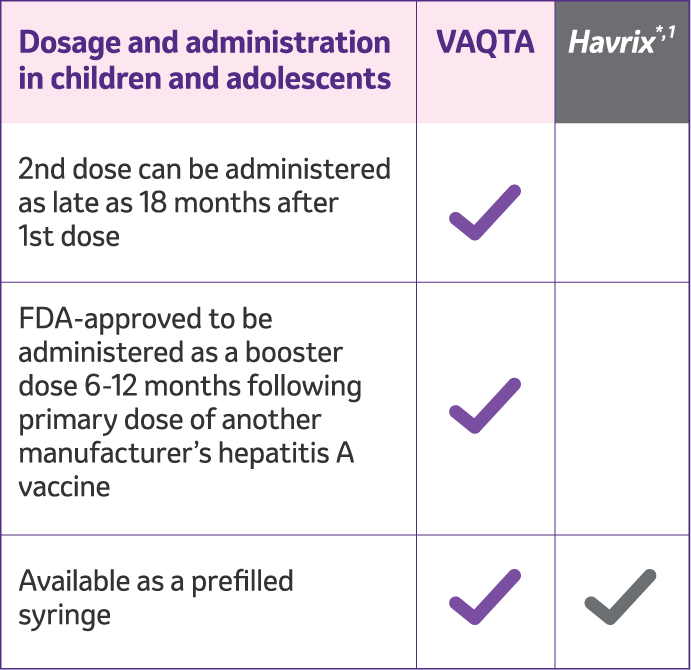
Available as a prefilled syringe
Prefilled Syringe of VAQTA® (Hepatitis A Vaccine, Inactivated) for Children and AdolescentsPrefilled Syringe of VAQTA® (Hepatitis A Vaccine, Inactivated) for Children and Adolescents

Not shown actual size

NDC 0006-4095-02

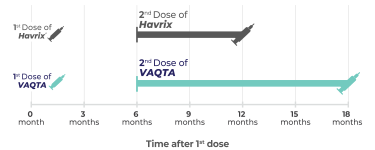
Flexible dosing window: VAQTA offers 6 more months compared to Havrix*,1

VAQTA offers a broader window for the 2nd dose

Flexible Dosing Schedule for 1st and 2nd Doses of VAQTA® (Hepatitis A Vaccine, Inactivated) Compared to HAVRIXFlexible Dosing Schedule for 1st and 2nd Doses of VAQTA® (Hepatitis A Vaccine, Inactivated) Compared to HAVRIX

Interchangeability

VAQTA can be administered 6 to 12 months following a first dose of Havrix*

*Havrix is a registered trademark of GSK.
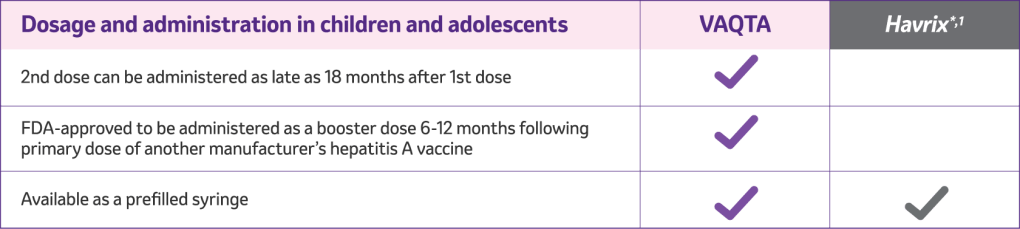
Dosage and Administration Information in Children and Adolescents for VAQTA® (Hepatitis A Vaccine, Inactivated) Compared to HAVRIXDosage and Administration Information in Children and Adolescents for VAQTA® (Hepatitis A Vaccine, Inactivated) Compared to HAVRIX

Vaccination opportunities

Well visits2-5

including back-to-school and sports-physical visits

Vaccine visits2-5

as appropriate

Sick visits2-5

Including injuries or mild illness

Review the vaccines VAQTA can be concomitantly administered with:

Concomitant administration

References

conDose

Indications and Usage

VAQTA® (Hepatitis A Vaccine, Inactivated) is indicated for the prevention of disease caused by hepatitis A virus (HAV) in persons 12 months of age and older. The primary dose should be given at least 2 weeks prior to expected exposure to HAV.

Select Safety Information

Do not administer VAQTA to individuals with a history of immediate and/or severe allergic or hypersensitivity reactions (eg, anaphylaxis) after a previous dose of any hepatitis A vaccine, or to individuals who have had an anaphylactic reaction to any component of VAQTA, including neomycin.

The vial stopper contains dry natural latex rubber that may cause allergic reactions in latex- sensitive individuals.

The most common local adverse reactions and systemic adverse events (≥15%) reported in different clinical trials across different age groups when VAQTA was administered alone or concomitantly were:

  • Children 12 through 23 months of age: injection-site pain/tenderness (37.0%), injection-site erythema (21.2%), and fever (16.4% when administered alone, and 27.0% when administered concomitantly).
  • Children/Adolescents 2 through 18 years of age: injection-site pain (18.7%).

Safety and effectiveness in infants below 12 months of age have not been established.

Immunocompromised persons, including individuals receiving immunosuppressive therapy, may have a diminished immune response to VAQTA and may not be protected against HAV infection after vaccination.

Hepatitis A virus has a relatively long incubation period (approximately 20 to 50 days). VAQTA may not prevent hepatitis A infection in individuals who have an unrecognized hepatitis A infection at the time of vaccination.

In clinical trials in children, VAQTA was concomitantly administered with one or more of the following US-licensed vaccines: Measles, Mumps, and Rubella Virus Vaccine, Live; Varicella Vaccine, Live; Diphtheria and Tetanus Toxoids and Acellular Pertussis Vaccine, Adsorbed; Measles, Mumps, Rubella, and Varicella Vaccine, Live; Pneumococcal 7-valent Conjugate Vaccine; and Haemophilus b Conjugate Vaccine (Meningococcal Protein Conjugate). Safety and immunogenicity were similar for concomitantly administered vaccines compared to separately administered vaccines.

The total duration of the protective effect of VAQTA in healthy vaccinees is unknown at present.

Vaccination with VAQTA may not result in a protective response in all susceptible vaccinees.


Dosage and Administration 

Children/Adolescents (12 months through 18 years of age): The vaccination schedule consists of a primary 0.5 mL dose administered intramuscularly and a 0.5 mL booster dose administered intramuscularly 6 to 18 months later.

Booster Immunization Following Another Manufacturer’s Hepatitis A Vaccine: A booster dose of VAQTA may be given at 6 to 12 months following a primary dose of Havrix*.

*Havrix is a registered trademark of GSK.
Before administering VAQTA, please read the accompanying Prescribing Information. The Patient Information also is available.

Indications and Usage
Select Safety Information

VAQTA® (Hepatitis A Vaccine, Inactivated) is indicated for the prevention of disease caused by hepatitis A virus (HAV) in persons 12 months of age and older. The primary dose should be given at least 2 weeks prior to expected exposure to HAV.

Select Safety Information

Do not administer VAQTA to individuals with a history of immediate and/or severe allergic or hypersensitivity reactions (eg, anaphylaxis) after a previous dose of any hepatitis A vaccine, or to individuals who have had an anaphylactic reaction to any component of VAQTA, including neomycin.

The vial stopper contains dry natural latex rubber that may cause allergic reactions in latex- sensitive individuals.

The most common local adverse reactions and systemic adverse events (≥15%) reported in different clinical trials across different age groups when VAQTA was administered alone or concomitantly were:

  • Children 12 through 23 months of age: injection-site pain/tenderness (37.0%), injection-site erythema (21.2%), and fever (16.4% when administered alone, and 27.0% when administered concomitantly).
  • Children/Adolescents 2 through 18 years of age: injection-site pain (18.7%).

Safety and effectiveness in infants below 12 months of age have not been established.

Immunocompromised persons, including individuals receiving immunosuppressive therapy, may have a diminished immune response to VAQTA and may not be protected against HAV infection after vaccination.

Hepatitis A virus has a relatively long incubation period (approximately 20 to 50 days). VAQTA may not prevent hepatitis A infection in individuals who have an unrecognized hepatitis A infection at the time of vaccination.

In clinical trials in children, VAQTA was concomitantly administered with one or more of the following US-licensed vaccines: Measles, Mumps, and Rubella Virus Vaccine, Live; Varicella Vaccine, Live; Diphtheria and Tetanus Toxoids and Acellular Pertussis Vaccine, Adsorbed; Measles, Mumps, Rubella, and Varicella Vaccine, Live; Pneumococcal 7-valent Conjugate Vaccine; and Haemophilus b Conjugate Vaccine (Meningococcal Protein Conjugate). Safety and immunogenicity were similar for concomitantly administered vaccines compared to separately administered vaccines.

The total duration of the protective effect of VAQTA in healthy vaccinees is unknown at present.

Vaccination with VAQTA may not result in a protective response in all susceptible vaccinees.


Dosage and Administration 

Children/Adolescents (12 months through 18 years of age): The vaccination schedule consists of a primary 0.5 mL dose administered intramuscularly and a 0.5 mL booster dose administered intramuscularly 6 to 18 months later.

Booster Immunization Following Another Manufacturer’s Hepatitis A Vaccine: A booster dose of VAQTA may be given at 6 to 12 months following a primary dose of Havrix*.

*Havrix is a registered trademark of GSK.

Before administering VAQTA, please read the accompanying Prescribing Information. The Patient Information also is available.