

Guidance on pediatric dosage and administration of VAXNEUVANCE

VAXNEUVANCE—a CDC, AAP, and AAFP recommended option for all of your appropriate pediatric patients—is administered as a 4-dose series1-3
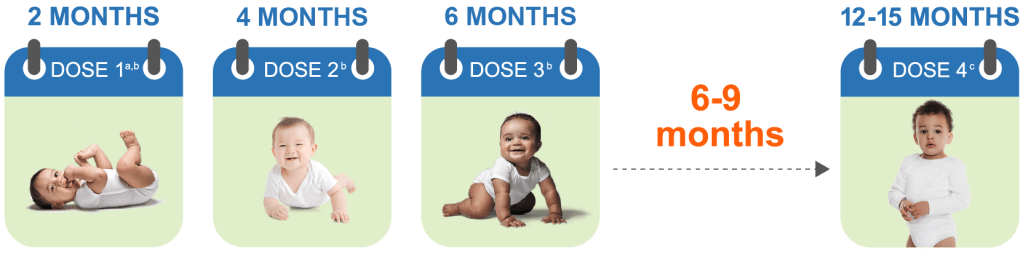
2 Months: 1st Dose(a,b); 4 Months: 2nd Dose(b); 6 Months: 3rd Dose(b); Infants Must Wait At Least 6-9 Months After the Last Infant Dose Until They're Able to Receive Their Toddler Dose; 12-15 Months: 4th Dose(c)2 Months: 1st Dose(a,b); 4 Months: 2nd Dose(b); 6 Months: 3rd Dose(b); Infants Must Wait At Least 6-9 Months After the Last Infant Dose Until They're Able to Receive Their Toddler Dose; 12-15 Months: 4th Dose(c)

Completion of the 4th dose is important to achieve and maintain serotype-specific immune responses.4

CDC recommendation on interchangeability1

VAXNEUVANCE is a CDC recommended option for a 4-dose series or for completion of a 4-dose series initiated with another PCV.

aDose 1 may be given as early as 6 weeks of age.
bThe recommended interval between doses is 4 to 8 weeks.
cThe 4th dose should be administered at approximately 12 through 15 months of age and at least 2 months after the 3rd dose.

How to administer VAXNEUVANCE

VAXNEUVANCE is for intramuscular injection only. Each dose is 0.5 mL.


Brands mentioned are trademarks of their respective owners.


AAP, American Academy of Pediatrics; AAFP, American Academy of Family Physicians; CDC, Centers for Disease Control and Prevention; PCV, pneumococcal conjugate vaccine; VFC, Vaccines for Children.

Learn about storage & handling information

Review CDC, AAP, and AAFP recommendations

Explore clinical data

See details on reimbursement

References:

  1. Centers for Disease Control and Prevention. Recommended child and adolescent immunization schedule for ages 18 years or younger, United States, 2025. Revised October 7, 2025. Accessed October 12, 2025. https://www.cdc.gov/vaccines/hcp/imz-schedules/downloads/child/0-18yrs-child-combined-schedule.pdf
  2. Immunization schedule. American Academy of Pediatrics. Last updated September 17, 2025. Accessed September 30, 2025. AAP.org/immunizationschedule
  3. American Academy of Family Physicians. Birth Through Age 18 Immunization Schedule. Last updated August 28, 2025. Accessed October 3, 2025. https://www.aafp.org/family-physician/patient-care/prevention-wellness/immunizations-vaccines/immunization-schedules/birth-through-age-18-immunization-schedule.html
  4. Recommendations to assure the quality, safety and efficacy of pneumococcal conjugate vaccines, Annex 3, TRS No 977. World Health Organization. October 19, 2013. Accessed February 26, 2025. https://www.who.int/publications/m/item/pneumococcal-conjugate-vaccines-annex3-trs-977
  5. Centers for Disease Control and Prevention (CDC). VFC. CDC Vaccine Price List. Updated October 6, 2025. Accessed October 10, 2025. https://www.cdc.gov/vaccines-for-children/php/awardees/current-cdc-vaccine-price-list.html
  6. Centers for Disease Control and Prevention. About the Vaccines for Children (VFC) Program. Reviewed June 26, 2024. Accessed October 10, 2025. https://www.cdc.gov/vaccines-for-children/about/index.html
ExternalSitePopup

Indications and Usage

VAXNEUVANCE® (Pneumococcal 15-valent Conjugate Vaccine) is indicated for active immunization for the prevention of invasive disease caused by Streptococcus pneumoniae serotypes 1, 3, 4, 5, 6A, 6B, 7F, 9V, 14, 18C, 19A, 19F, 22F, 23F, and 33F in individuals 6 weeks of age and older.

Select Safety Information

Do not administer VAXNEUVANCE® (Pneumococcal 15-valent Conjugate Vaccine) to individuals with a severe allergic reaction (eg, anaphylaxis) to any component of VAXNEUVANCE or to diphtheria toxoid.


Some individuals with altered immunocompetence, including those receiving immunosuppressive therapy, may have a reduced immune response to VAXNEUVANCE.


Apnea following intramuscular vaccination has been observed in some infants born prematurely. Vaccination of premature infants should be based on the infant’s medical status and the potential benefits and possible risks.


The most commonly reported solicited adverse reactions in children vaccinated at 2, 4, 6, and 12 through 15 months of age, provided as a range across the 4-dose series, were: irritability (57.3% to 63.4%), somnolence (24.2% to 47.5%), injection-site pain (25.9% to 40.3%), fever ≥38.0°C (13.3% to 20.4%), decreased appetite (14.1% to 19.0%), injection-site induration (13.2% to 15.4%), injection-site erythema (13.7% to 21.4%), and injection-site swelling (11.3% to 13.4%).


The most commonly reported solicited adverse reactions in children 2 through 17 years of age vaccinated with a single dose were: injection-site pain (54.8%), myalgia (23.7%), injection-site swelling (20.9%), injection-site erythema (19.2%), fatigue (15.8%), headache (11.9%), and injection-site induration (6.8%).


The reported solicited adverse reactions in children 7 through 11 months of age who received 3 doses of VAXNEUVANCE were: fever ≥38.0°C (21.9%), irritability (32.8%), injection-site erythema (28.1%), somnolence (21.9%), injection-site swelling (18.8%), injection-site pain (18.8%), injection-site induration (17.2%), decreased appetite (15.6%), and urticaria (1.6%).


The reported solicited adverse reactions in children 12 through 23 months of age who received 2 doses of VAXNEUVANCE were: fever ≥38.0°C (11.3%), irritability (35.5%), injection-site pain (33.9%), somnolence (24.2%), decreased appetite (22.6%), injection-site erythema (21.0%), injection-site swelling (14.5%), and injection-site induration (8.1%).


Vaccination with VAXNEUVANCE may not protect all vaccine recipients.


Before administering VAXNEUVANCE, please read the accompanying Prescribing Information. The Patient Information also is available.

Indications and Usage
Select Safety Information

VAXNEUVANCE® (Pneumococcal 15-valent Conjugate Vaccine) is indicated for active immunization for the prevention of invasive disease caused by Streptococcus pneumoniae serotypes 1, 3, 4, 5, 6A, 6B, 7F, 9V, 14, 18C, 19A, 19F, 22F, 23F, and 33F in individuals 6 weeks of age and older.

Select Safety Information

Do not administer VAXNEUVANCE® (Pneumococcal 15-valent Conjugate Vaccine) to individuals with a severe allergic reaction (eg, anaphylaxis) to any component of VAXNEUVANCE or to diphtheria toxoid.


Some individuals with altered immunocompetence, including those receiving immunosuppressive therapy, may have a reduced immune response to VAXNEUVANCE.


Apnea following intramuscular vaccination has been observed in some infants born prematurely. Vaccination of premature infants should be based on the infant’s medical status and the potential benefits and possible risks.


The most commonly reported solicited adverse reactions in children vaccinated at 2, 4, 6, and 12 through 15 months of age, provided as a range across the 4-dose series, were: irritability (57.3% to 63.4%), somnolence (24.2% to 47.5%), injection-site pain (25.9% to 40.3%), fever ≥38.0°C (13.3% to 20.4%), decreased appetite (14.1% to 19.0%), injection-site induration (13.2% to 15.4%), injection-site erythema (13.7% to 21.4%), and injection-site swelling (11.3% to 13.4%).


The most commonly reported solicited adverse reactions in children 2 through 17 years of age vaccinated with a single dose were: injection-site pain (54.8%), myalgia (23.7%), injection-site swelling (20.9%), injection-site erythema (19.2%), fatigue (15.8%), headache (11.9%), and injection-site induration (6.8%).


The reported solicited adverse reactions in children 7 through 11 months of age who received 3 doses of VAXNEUVANCE were: fever ≥38.0°C (21.9%), irritability (32.8%), injection-site erythema (28.1%), somnolence (21.9%), injection-site swelling (18.8%), injection-site pain (18.8%), injection-site induration (17.2%), decreased appetite (15.6%), and urticaria (1.6%).


The reported solicited adverse reactions in children 12 through 23 months of age who received 2 doses of VAXNEUVANCE were: fever ≥38.0°C (11.3%), irritability (35.5%), injection-site pain (33.9%), somnolence (24.2%), decreased appetite (22.6%), injection-site erythema (21.0%), injection-site swelling (14.5%), and injection-site induration (8.1%).


Vaccination with VAXNEUVANCE may not protect all vaccine recipients.


Before administering VAXNEUVANCE, please read the accompanying Prescribing Information. The Patient Information also is available.