


Guidance on pediatric dosage and administration of VAXNEUVANCE
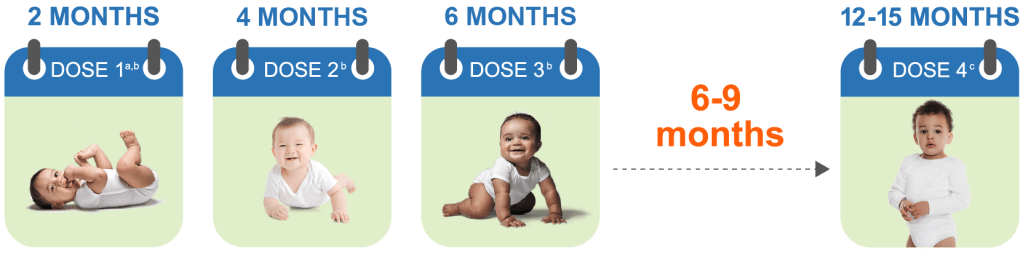
VAXNEUVANCE—a CDC, AAP, and AAFP recommended option for all of your appropriate pediatric patients—is administered as a 4-dose series1-3


CDC recommendation on interchangeability1
VAXNEUVANCE is a CDC recommended option for a 4-dose series or for completion of a 4-dose series initiated with another PCV.
aDose 1 may be given as early as 6 weeks of age.
bThe recommended interval between doses is 4 to 8 weeks.
cThe 4th dose should be administered at approximately 12 through 15 months of age and at least 2 months after the 3rd dose.
How to administer VAXNEUVANCE
VAXNEUVANCE is for intramuscular injection only. Each dose is 0.5 mL.
VAXNEUVANCE may appear as a clear liquid with precipitate before shaking. Immediately before use and prior to attaching the needle and expelling air from the syringe, hold the prefilled syringe horizontally and shake vigorously to obtain an opalescent suspension. Multiple attempts may be required to achieve complete resuspension. Do not use the vaccine if it cannot be resuspended. Parenteral drug products should be inspected visually for particulate matter and discoloration prior to administration, whenever solution and container permit. Do not use if particulate matter is present after vigorous shaking or discoloration is observed.


VAXNEUVANCE can be given with other routinely administered vaccines (including Pentacel, RECOMBIVAX HB®, RotaTeq®, M-M-R®II, VAQTA®, VARIVAX®, and Hiberix).
Brands mentioned are trademarks of their respective owners.

You have brand choice in the Vaccines for Children Program—choose VAXNEUVANCE for your enrolled patients.5,6
Parents and caregivers of your pediatric patients may be unaware of vaccination programs, such as the VFC Program. VFC is a federally funded vaccine program that provides recommended vaccines to eligible children and adolescents who might not otherwise be able to afford them.6
AAP, American Academy of Pediatrics; AAFP, American Academy of Family Physicians; CDC, Centers for Disease Control and Prevention; PCV, pneumococcal conjugate vaccine; VFC, Vaccines for Children.
Learn about storage & handling information
Review CDC, AAP, and AAFP recommendations
Explore clinical data
See details on reimbursement
References:
- Centers for Disease Control and Prevention (CDC). Child and adolescent immunization schedule by age: recommendations for ages 18 years or younger, United States, 2025. Addendum updated July 2, 2025. Accessed April 22, 2026. https://www.cdc.gov/vaccines/hcp/imz-schedules/child-adolescent-age.html
- American Academy of Pediatrics (AAP). Recommended child and adolescent immunization schedule for ages 18 years or younger, United States 2026. Updated February 5, 2026. Accessed April 7, 2026. https://downloads.aap.org/AAP/PDF/AAP-Immunization-Schedule.pdf
- American Academy of Family Physicians (AAFP). Birth through age 18 immunization schedule. Last updated March 1, 2026. Accessed April 22, 2026. https://www.aafp.org/family-physician/patient-care/prevention-wellness/immunizations-vaccines/immunization-schedules/birth-through-age-18-immunization-schedule.html
- Recommendations to assure the quality, safety and efficacy of pneumococcal conjugate vaccines, Annex 3, TRS No 977. World Health Organization. October 19, 2013. Accessed May 8, 2026. https://www.who.int/publications/m/item/pneumococcal-conjugate-vaccines-annex3-trs-977
- Centers for Disease Control and Prevention (CDC). VFC. CDC Vaccine Price List. Updated May 1, 2026. Accessed May 8, 2026. https://www.cdc.gov/vaccines-for-children/php/price-list/index.html
- Centers for Disease Control and Prevention (CDC). About the Vaccines for Children (VFC) Program. Updated September 30, 2025. Accessed February 13, 2026. https://www.cdc.gov/vaccines-for-children/about/index.html