Actor Portrayal

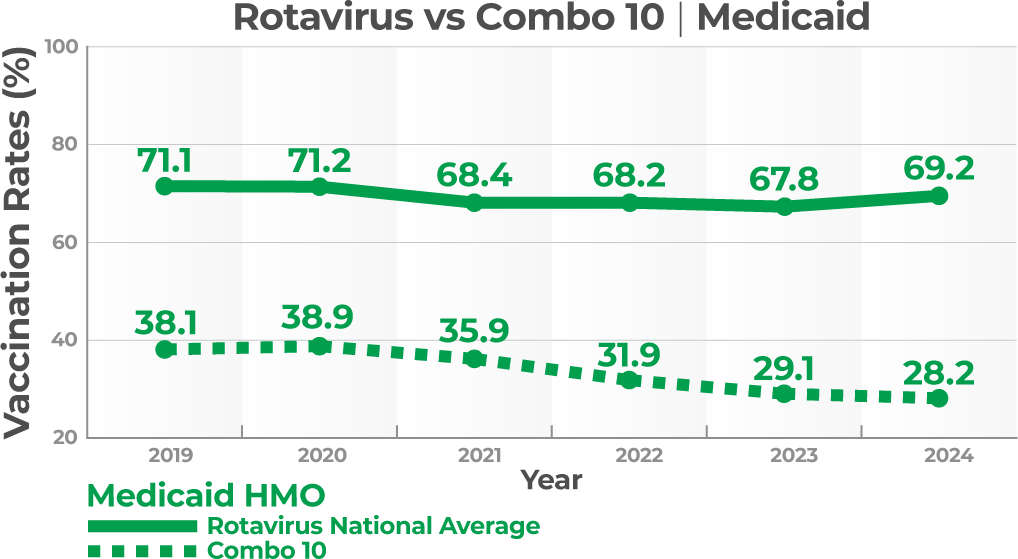
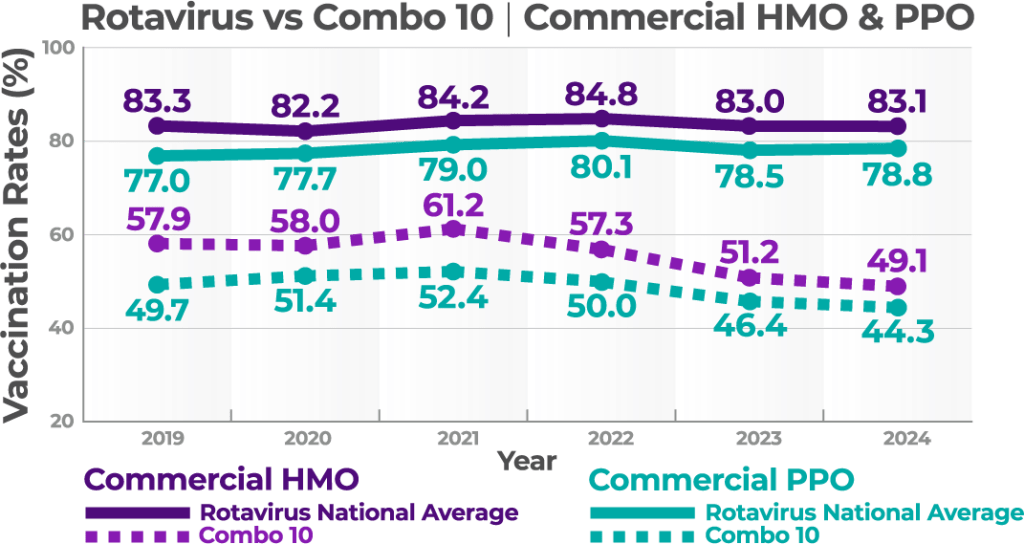
Rotavirus vaccinesa are part of the HEDIS Combo 101

HEDIS measures the percentage of children 2 years of age who have received 10 specific vaccines.1

Rotavirus vaccination rates versus Combo 10 vaccination rates

HEDIS, Healthcare Effectiveness Data and Information Set; NCQA, National Committee for Quality Assurance; HMO, Health Maintenance Organization; PPO, Preferred Provider Organization.


Storage and handling

Find out how to store and handle RotaTeq in your practice.

Learn more about storage and handling

References

  1. Childhood Immunization Status – NCQA. NCQA. Published 2018. Accessed April 10, 2026. https://www.ncqa.org/report-cards/health-plans/state-of-health-care-quality-report/childhood-immunization-status-cis/
  2. Rotarix. Prescribing Information. GSK; 2024.
  3. Office of Disease Prevention and Health Promotion, US Department of Health and Human Services. Reduce the proportion of children who get no recommended vaccines by age 2 years — IID‑02 – Healthy People 2030. Accessed April 10, 2026. https://odphp.health.gov/healthypeople/objectives-and-data/browse-objectives/vaccination/reduce-proportion-children-who-get-no-recommended-vaccines-age-2-years-iid-02

Indications and Usage

RotaTeq is indicated for the prevention of rotavirus gastroenteritis in infants and children caused by Types G1, G2, G3, G4, and G9 when administered as a 3-dose series to infants between the ages of 6 to 32 weeks. The first dose of RotaTeq should be administered between 6 and 12 weeks of age.

The vaccination series consists of 3 ready-to-use liquid doses of RotaTeq administered orally starting at 6 to 12 weeks of age, with the subsequent doses administered at 4- to 10-week intervals. The third dose should not be given after 32 weeks of age.

Selected Safety Information

RotaTeq is contraindicated in infants with a demonstrated history of hypersensitivity to the vaccine or any component of the vaccine.

RotaTeq is contraindicated in infants with Severe Combined Immunodeficiency Disease (SCID). These infants should not receive RotaTeq. Post-marketing reports of gastroenteritis, including severe diarrhea and prolonged shedding of vaccine virus, have been reported in infants who were administered RotaTeq and later identified as having SCID.

RotaTeq is contraindicated in infants with a history of intussusception. These infants should not receive RotaTeq.

No safety or efficacy data are available from clinical trials regarding the administration of RotaTeq to infants who are potentially immunocompromised.

In a post-marketing observational study in the US, cases of intussusception were observed in temporal association within 21 days following the first dose of RotaTeq, with a clustering of cases in the first 7 days.

No safety or efficacy data are available for administration of RotaTeq to infants with a history of gastrointestinal disorders.

Vaccine virus transmission from vaccine recipient to nonvaccinated contacts has been reported. Caution is advised when considering whether to administer RotaTeq to individuals with immunodeficient contacts.

In clinical trials, the most common adverse events included diarrhea, vomiting, irritability, otitis media, nasopharyngitis, and bronchospasm.

In post-marketing experience, intussusception (including death) and Kawasaki disease have been reported in infants who have received RotaTeq.

RotaTeq may not protect all vaccine recipients against rotavirus.

Before administering RotaTeq, please read the accompanying Prescribing Information. The Patient Product Information also is available.

Indications and Usage
Selected Safety Information

RotaTeq is indicated for the prevention of rotavirus gastroenteritis in infants and children caused by Types G1, G2, G3, G4, and G9 when administered as a 3-dose series to infants between the ages of 6 to 32 weeks. The first dose of RotaTeq should be administered between 6 and 12 weeks of age.

The vaccination series consists of 3 ready-to-use liquid doses of RotaTeq administered orally starting at 6 to 12 weeks of age, with the subsequent doses administered at 4- to 10-week intervals. The third dose should not be given after 32 weeks of age.

Selected Safety Information

RotaTeq is contraindicated in infants with a demonstrated history of hypersensitivity to the vaccine or any component of the vaccine.

RotaTeq is contraindicated in infants with Severe Combined Immunodeficiency Disease (SCID). These infants should not receive RotaTeq. Post-marketing reports of gastroenteritis, including severe diarrhea and prolonged shedding of vaccine virus, have been reported in infants who were administered RotaTeq and later identified as having SCID.

RotaTeq is contraindicated in infants with a history of intussusception. These infants should not receive RotaTeq.

No safety or efficacy data are available from clinical trials regarding the administration of RotaTeq to infants who are potentially immunocompromised.

In a post-marketing observational study in the US, cases of intussusception were observed in temporal association within 21 days following the first dose of RotaTeq, with a clustering of cases in the first 7 days.

No safety or efficacy data are available for administration of RotaTeq to infants with a history of gastrointestinal disorders.

Vaccine virus transmission from vaccine recipient to nonvaccinated contacts has been reported. Caution is advised when considering whether to administer RotaTeq to individuals with immunodeficient contacts.

In clinical trials, the most common adverse events included diarrhea, vomiting, irritability, otitis media, nasopharyngitis, and bronchospasm.

In post-marketing experience, intussusception (including death) and Kawasaki disease have been reported in infants who have received RotaTeq.

RotaTeq may not protect all vaccine recipients against rotavirus.

Before administering RotaTeq, please read the accompanying Prescribing Information. The Patient Product Information also is available.